
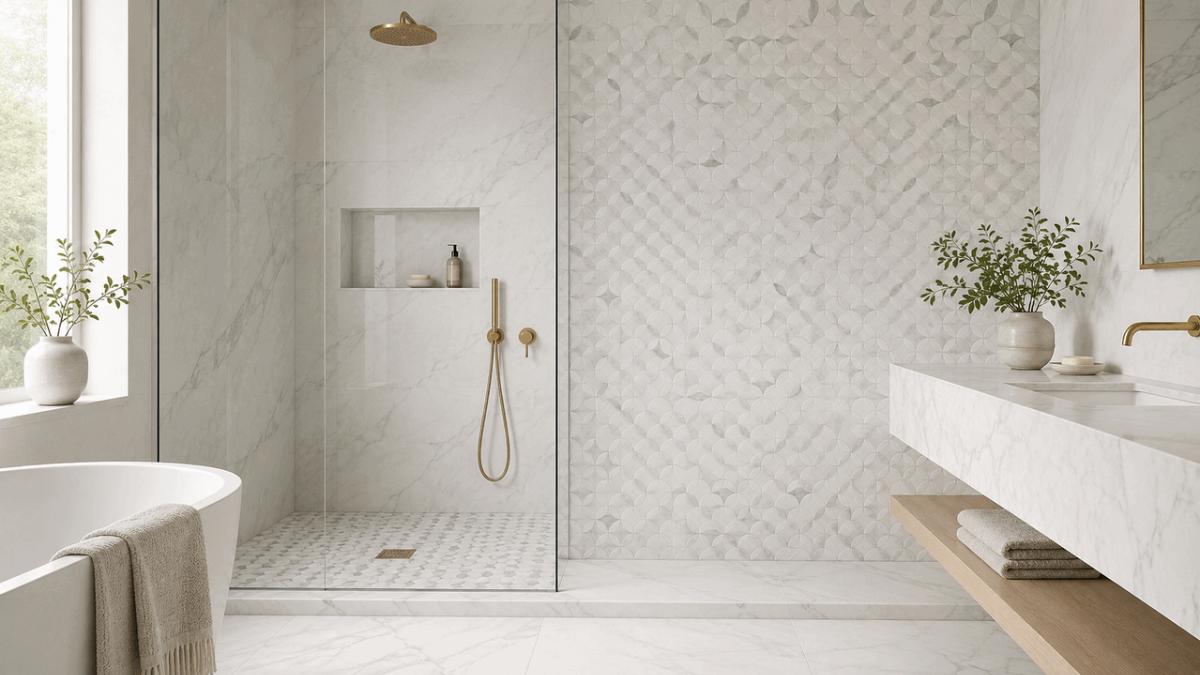
The right tile does more than cover a wall or floor. It changes the way a room feels.
A carefully selected marble mosaic can make a compact kitchen appear more refined, give a plain shower the atmosphere of a private spa, or turn an overlooked wall into the most memorable feature in the home. Yet choosing natural stone is not as simple as pointing to the first attractive pattern. Marble varies in color, veining, finish, texture, size, and performance. Two mosaics that look similar in a photograph may behave very differently once installed.
When searching for marble mosaic tile for sale, buyers should consider the complete project rather than focusing only on appearance. Where will the tile be installed? How much water, grease, foot traffic, or cleaning will it face? Does the room need visual movement, a calm background, or a dramatic centerpiece?
These questions matter.
Surfaces Galore offers a broad selection of natural marble mosaics in stones such as Carrara White, Calacatta Gold, Thassos White, Dolomite, Crema Marfil, Emperador, Statuario, and other distinctive varieties. The collection includes familiar formats as well as more decorative designs, giving homeowners, designers, builders, and commercial buyers room to create something genuinely individual.
Why Marble Mosaic Remains So Desirable
Marble has been used in architecture for centuries, but its appeal is not based on tradition alone. Natural stone has depth. Its color is not printed onto the surface, and its pattern is not mechanically repeated every few tiles. Each piece carries small mineral variations, veins, cloudy sections, and subtle tonal differences.
That irregularity is exactly what gives marble its character.
A manufactured tile may offer near-perfect consistency. Marble offers something different: controlled variation. Once dozens or hundreds of small pieces are arranged into a mosaic, those natural differences create movement across the surface.
“Will every sheet look exactly like the sample?” is a common question.
The honest answer is no—and that is usually a benefit, not a flaw. A sample shows the general character of the stone, but natural marble will always include variation. Buyers who understand this before ordering are more likely to appreciate the finished installation rather than being surprised by it.
When comparing options for marble mosaic tile for sale, it helps to think of the material as a collection of related pieces rather than a perfectly uniform product.
Marble Mosaic Tile Versus Standard Marble Tile
Large-format marble tiles and marble mosaics can be made from the same stone, yet they produce very different effects.
Standard marble tiles usually create a cleaner, broader surface with fewer grout lines. They are often selected for bathroom walls, entry floors, fireplace surrounds, or other areas where the veining of the stone should remain highly visible.
Mosaics use smaller pieces, often mounted on mesh sheets for easier positioning. These pieces may be arranged in geometric or decorative patterns such as:
• Herringbone• Hexagon• Penny round• Basketweave• Octagon and dot• Arabesque• Pinwheel• Picket• Lantern• Diamond• Checkerboard• Random strip• Fan or fish-scale patterns
The extra grout lines create texture and definition. They can also improve grip, which is especially important when selecting a marble shower floor tile.
Mosaics are also more flexible than large tiles. A mesh-backed sheet can adapt more easily to shower slopes, curved surfaces, niches, borders, and irregular areas. That makes mosaic formats both decorative and practical.
How to Evaluate Marble Mosaic Tile for Sale
A beautiful product image may capture attention, but several technical details determine whether a tile is right for the project.
Consider the Marble Variety
Different marble varieties create noticeably different moods.
Carrara White usually has a white or light-gray background with soft gray veining. It works well in traditional bathrooms, transitional kitchens, and understated interiors.
Calacatta Gold is generally more dramatic. Its veining can be bolder, with warm gold or beige tones that pair particularly well with brass fixtures, cream cabinetry, and warm wood finishes.
Thassos White is known for its clean, bright appearance. It can make smaller bathrooms and darker kitchens feel lighter, especially when used in a polished finish.
Emperador marble introduces brown and earthy shades. It creates greater contrast and can work beautifully in formal powder rooms, traditional homes, bars, and fireplace installations.
Crema Marfil provides a warmer beige tone, making it useful when bright white marble would feel too cold.
There is no universally correct choice. The best stone depends on the surrounding materials, lighting, and desired atmosphere.
Select the Right Pattern
Pattern affects more than style. It can alter the visual proportions of the room.
Herringbone creates direction and energy. On a backsplash, it can draw the eye upward or across the countertop. Hexagon mosaics offer a structured geometric appearance that works in both historic and modern interiors. Penny rounds feel softer and often create a classic bathroom look. Basketweave patterns suggest traditional craftsmanship and suit spaces that need architectural detail.
More complex mosaics can become the focal point. Simpler patterns are easier to use across larger surfaces.
A useful rule is this: the more movement already present in the marble, the less complicated the pattern may need to be. Strong veining combined with an intricate layout can look expressive, but it can also overwhelm a small room.
Compare Available Finishes
Finish changes the appearance, texture, and practical behavior of marble.
Polished marble reflects light and emphasizes color and veining. It often looks formal, crisp, and luxurious. It is a popular choice for backsplashes, decorative walls, niches, and other surfaces where slip resistance is not a major concern.
Honed marble has a smooth matte or satin surface. It feels quieter and more contemporary. Because it is less reflective, honed marble can hide light scratches and water spotting more effectively than polished stone.
Tumbled marble has softened edges and a weathered appearance. It introduces texture and works well in rustic, Mediterranean, traditional, and old-world interiors. The irregularity is intentional. Buyers should not expect every edge to be perfectly sharp or identical.
Textured, brushed, or leathered finishes offer additional grip and visual depth. These can be particularly useful in wet locations.
Designing a Marble Backsplash Tile Installation
A marble backsplash tile sits at eye level, often directly beneath cabinets, shelves, or a range hood. That means the pattern is highly visible and should relate clearly to the rest of the kitchen.
The backsplash may serve one of two roles.
It can be a quiet background that supports the countertop, cabinetry, hardware, and lighting. Alternatively, it can become the dominant decorative feature. Both approaches can work, but the decision should be intentional.
Matching Marble With the Countertop
A common mistake is choosing the backsplash and countertop independently.
Imagine a kitchen with a heavily veined quartz countertop. Adding an equally bold Calacatta mosaic may create too many competing lines. A calmer Carrara mosaic, simple Thassos pattern, or lightly veined honed marble could provide better balance.
Now consider a kitchen with a plain white countertop and flat-front cabinets. In that setting, a dramatic marble backsplash tile in herringbone, arabesque, or geometric Calacatta may bring the needed personality.
The goal does not have to be an exact match. In fact, trying to match two different stone products perfectly can be frustrating. It is often more successful to choose materials that coordinate in temperature and contrast.
Warm countertops generally pair best with marble containing cream, beige, brown, or gold tones. Cooler gray and white surfaces tend to suit Carrara, Dolomite, Statuario, and similar stones.
Think About Grout Color
Grout can either reveal or soften the pattern.
A contrasting grout highlights every joint. Darker grout around white marble makes hexagons, herringbone pieces, and penny rounds appear more graphic. A closely matched grout color creates a quieter, more unified surface.
There is a compromise, though. Very light grout can show cooking residue more quickly behind a range, while dark grout may emphasize even slight variations in joint width.
For many marble backsplashes, a soft gray, warm white, or stone-colored grout offers a practical middle ground.
Protecting a Kitchen Backsplash
Marble is a natural calcium-based stone. Acidic substances such as lemon juice, vinegar, tomato sauce, and certain cleaning products can etch its surface. Oil and pigments may also stain unsealed stone.
This does not mean marble should be avoided in kitchens. It means expectations and maintenance should be realistic.
A suitable penetrating sealer can reduce absorption, although it does not make marble completely immune to staining or etching. Splashes should be wiped away rather than left overnight, and harsh acidic cleaners should not be used.
For a backsplash, this level of care is usually manageable. The surface is vertical, so liquids do not sit on it as readily as they might on a countertop.
Choosing Marble Shower Floor Tile Safely
A shower floor must look good, but it also needs to handle water, soap, slope, grout, drainage, and daily foot traffic. These practical demands should guide the selection.
Large polished marble tiles are generally not the first choice for a wet shower floor. The smooth surface can become slippery, and larger rigid tiles are harder to install properly across the multiple slopes leading toward a drain.
Small mosaics perform differently.
A marble shower floor tile made from small pieces creates numerous grout joints. Those joints help increase traction underfoot. Mesh-mounted mosaics can also follow the slope of the shower base more effectively.
Appropriate Formats for Shower Floors
Penny rounds are popular because they create many grout lines and fit curves or slopes well. Small hexagons offer similar advantages with a more geometric appearance. Small squares provide a traditional look and straightforward layout. Basketweave and compact decorative mosaics can introduce greater visual detail.
Herringbone can also work, although the installer must take care around the drain and edges because the pattern includes more directional cuts.
The finish remains important. Honed, tumbled, brushed, and textured surfaces usually make more sense underfoot than highly polished marble.
Installation Quality Is Critical
Even the best marble shower floor tile can fail when installed incorrectly.
The shower base must be properly waterproofed and sloped. The tile should receive adequate mortar coverage, with no large voids beneath the stone. Incomplete coverage can contribute to loose pieces, trapped moisture, discoloration, or cracking.
The drain must also sit correctly relative to the tile thickness. Grout joints should be filled consistently, and movement joints should be placed where required.
This is not the area to choose an installer based only on the lowest quotation.
A contractor experienced with natural stone will understand that marble behaves differently from ordinary ceramic tile. They will know how to manage sheet alignment, variation, sealing, mortar selection, and cutting without damaging delicate pieces.
A Practical Design Scenario
Consider a homeowner renovating a narrow primary bathroom with limited natural light.
The initial idea is to cover every surface in polished white marble. It sounds elegant, but the room could become visually cold, and a polished shower floor might not provide enough grip.
A more balanced plan would use large honed Carrara tiles on the main shower walls, a small Carrara hexagon marble shower floor tile, and a decorative Calacatta Gold mosaic inside the shower niche. Warm brass fixtures could pick up the subtle gold tones, while a pale gray grout would define the floor without creating harsh contrast.
The result would still feel luxurious, but each material would have a clear function.
The larger wall tiles would reduce grout maintenance. The mosaic floor would adapt to the shower slope and add traction. The niche would provide a concentrated decorative moment rather than filling the entire room with competing patterns.
This is the kind of planning that separates a merely expensive bathroom from a well-designed one.
Common Problems and How to Avoid Them
Visible Sheet Lines
Mesh-mounted mosaics are installed in sheets. When those sheets are placed too far apart or too close together, the outline of each sheet may remain visible after grouting.
A skilled installer should dry-lay several sheets and adjust individual pieces where necessary. The spacing between sheets must resemble the spacing within each sheet.
Variation That Feels Too Strong
Natural marble can contain greater color or veining variation than expected.
The solution is not to install one box at a time. Tiles should be opened and blended from multiple boxes before setting begins. This distributes darker, lighter, and more heavily veined pieces across the full area.
Reviewing the dry layout before installation is especially important for prominent backsplashes and feature walls.
Staining or Darkening
Marble may temporarily darken when wet because moisture enters the stone. In a properly constructed shower, it should dry between uses. Persistent dark areas can indicate trapped moisture, insufficient drainage, or installation problems.
Proper waterproofing, mortar coverage, drainage, sealing, and ventilation all play a role.
Etching
Etching is a chemical reaction that dulls the surface of marble. It is most visible on polished finishes.
Sealer does not prevent etching. The best protection is to avoid acidic cleaners and remove acidic spills promptly. In busy kitchens where a completely unchanged surface is expected, honed marble may be more forgiving than polished marble.
Ordering Too Little Material
Mosaics involve cuts, alignment, pattern matching, and occasional piece replacement. Ordering exactly the measured square footage leaves no margin for mistakes or future repairs.
An additional allowance is normally recommended. The percentage depends on the layout, room shape, pattern complexity, and installer’s cutting plan. Straightforward areas may require less extra material, while diagonal patterns, niches, borders, and irregular rooms may require more.
Why Samples Matter Before Ordering
Screen colors can vary, and natural stone is difficult to judge from a single product image. A sample lets the buyer see the actual color temperature, finish, veining, edge detail, and scale of the pattern.
It should be viewed in the room where it will be installed.
Kitchen lighting can make white marble appear warm, cool, gray, or cream. Bathroom lighting can exaggerate polished reflections. Nearby cabinet colors may bring out undertones that were not obvious online.
Place the sample next to the countertop, paint, flooring, fixtures, and grout options. Look at it during the morning, afternoon, and evening.
This simple step prevents many expensive design mistakes.
How to Compare Marble Mosaic Tile for Sale Online
A large collection can initially feel overwhelming. Narrowing the search by application makes the process easier.
For a kitchen, focus on backsplash-compatible patterns and finishes. For a shower floor, prioritize small formats, suitable texture, and manageable grout joints. For a decorative wall, consider pattern scale, viewing distance, and how much visual movement the room can support.
When reviewing marble mosaic tile for sale, check:
• Marble type and country of origin• Individual tile dimensions• Sheet dimensions• Thickness• Finish• Edge treatment• Recommended applications• Mesh mounting• Coverage per sheet or piece• Expected color variation• Sealing requirements• Availability of matching field tile, trim, or molding
Surfaces Galorecarries an extensive natural stone selection, including hundreds of marble mosaic options across numerous shapes, finishes, and color families. This range makes it possible to coordinate mosaics with larger marble tiles or use them independently as feature materials.
Marble Mosaic in Traditional and Modern Interiors
Marble is sometimes treated as exclusively traditional, but pattern and finish can change its personality completely.
A tumbled Crema Marfil mosaic with softened edges may feel old-world and relaxed. A polished Calacatta Gold arabesque can appear ornate and expressive. A honed Thassos herringbone feels clean and architectural. A black-and-white checkerboard introduces vintage character, while a geometric Dolomite mosaic can suit a minimalist bathroom.
The surrounding details matter just as much.
Modern cabinetry, simple lighting, and restrained hardware can make classic marble feel contemporary. Decorative moldings, framed niches, warm metals, and detailed woodwork can push the same stone toward a more traditional direction.
This adaptability is one reason marble mosaics remain relevant across changing interior trends.
Is Marble Worth the Maintenance?
For some buyers, absolutely. For others, porcelain may be the better choice.
Marble develops signs of use. It can etch, darken temporarily, acquire fine scratches, or develop a patina. People who expect a perfectly unchanged surface may find this frustrating.
Those who appreciate natural materials often see the same changes differently. They view them as part of the stone’s character.
Neither perspective is wrong.
The important point is to choose with accurate expectations. Marble is not maintenance-free, but it does not require constant anxiety either. Appropriate sealing, gentle cleaning, fast response to spills, and correct installation can preserve its appearance for many years.
Final Recommendation
When choosing marble mosaic tile for sale, begin with the location and practical requirements, then move to color and pattern. A backsplash can support polished, intricate designs because it does not need to provide traction. A shower floor should favor smaller pieces, added grout lines, and a suitable finish. A decorative wall allows greater freedom, but the scale of the pattern should still suit the room.
Order samples. Compare them in the actual space. Blend material from multiple boxes. Use a contractor familiar with natural stone. Purchase enough extra tile to cover cutting, variation, and future repairs.
Most importantly, do not treat marble as if it were a perfectly printed surface. Its variations are the reason each installation feels individual.
A thoughtfully selected marble backsplash tile can give a kitchen architectural depth. The right marble shower floor tile can combine comfort, traction, and natural beauty. And a well-chosen mosaic from Surfaces Galore can turn an ordinary renovation into a space that still feels special long after the work is complete.